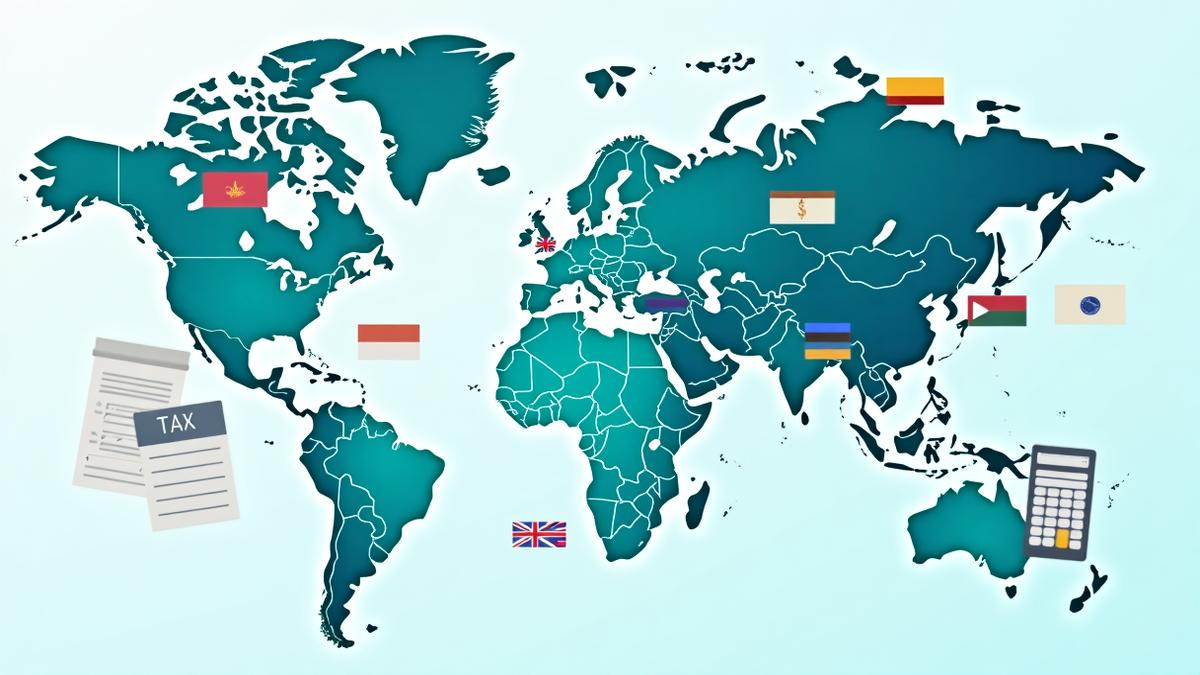
Understanding how different countries tax personal income is crucial for anyone considering international work, relocation, or simply wanting to understand global economic systems. The G20 countries—representing the world's largest economies—employ vastly different tax systems, from the progressive brackets of the United States to the high social security contributions of France and Germany.
What Makes Each Tax System Unique?
Tax systems across the G20 vary dramatically in structure, rates, and complexity. While most developed nations use progressive tax systems (where higher earners pay higher rates), the specific brackets, deductions, and social security contributions create significantly different tax burdens.
Progressive Tax Brackets Explained
Progressive taxation means that as your income increases, you pay a higher percentage on the additional income. Importantly, you don't pay the higher rate on all your income—only on the portion that falls into each bracket.
Example (United States): If you earn $100,000 as a single filer:
- The first $11,000 is taxed at 10% = $1,100
- Income from $11,000 to $44,725 is taxed at 12% = $4,047
- Income from $44,725 to $95,375 is taxed at 22% = $11,143
- Income from $95,375 to $100,000 is taxed at 24% = $1,110
- Total federal income tax: ~$17,400 (17.4% effective rate)
This is why your "marginal tax rate" (the rate on your last dollar earned) differs from your "effective tax rate" (the percentage of your total income paid in taxes).
G20 Tax Systems: Country-by-Country Breakdown
🇺🇸 United States (10-37%)
The US employs a seven-bracket progressive federal income tax system ranging from 10% to 37%. However, most Americans also pay state income taxes (0-13% depending on state), Social Security tax (6.2% up to $160,200), and Medicare tax (1.45% with no cap, plus 0.9% for high earners).
Key Features:
- Standard deductions reduce taxable income ($13,850 single / $27,700 married filing jointly)
- Tax filing deadline: April 15
- State taxes add significant complexity and vary dramatically by location
🇬🇧 United Kingdom (0-45%)
The UK tax system has four bands: Personal Allowance (0%, up to £12,570), Basic Rate (20%), Higher Rate (40%), and Additional Rate (45%). National Insurance contributions add 12% on earnings between £12,570-£50,270, then drop to 2% above that threshold.
Notable Aspects:
- Scotland has different income tax rates and bands
- National Insurance is essentially a second income tax
- Tax year runs April 6 - April 5 (not calendar year)
🇨🇦 Canada (15-33% federal + provincial)
Canada has a dual tax system with federal rates (15%, 20.5%, 26%, 29%, 33%) plus provincial taxes (5-21% depending on province). This creates combined marginal rates as high as 54% in some provinces for top earners.
Key Points:
- CPP (Canada Pension Plan) contributions: 5.95% employee + 5.95% employer
- Employment Insurance: 1.63% on earnings up to $63,200
- Basic Personal Amount: $15,000 (federal deduction)
🇦🇺 Australia (0-45%)
Australia has a five-tier progressive system with a generous tax-free threshold of $18,200 (AUD). The 2% Medicare Levy applies to most taxpayers, and there's no separate Social Security tax like in the US.
Employers pay 11.5% superannuation (retirement) contributions on top of salary, making total compensation packages more transparent than in many countries.
🇩🇪 Germany (0-45%)
Germany has high tax rates and exceptionally high social security contributions. The "rich tax" (Reichensteuer) of 45% kicks in at €277,825. Additionally, there's a 5.5% solidarity surcharge on income tax, though it's being phased out for lower earners.
Social Insurance Contributions (Employee + Employer):
- Pension insurance: 18.6% (split between employer/employee)
- Health insurance: ~14.6%
- Unemployment insurance: 1.3%
- Long-term care insurance: 0.4%
- Total: ~35% combined employer/employee contributions
🇫🇷 France (0-45%)
France has one of the world's most complex tax systems with rates from 11% to 45%, plus CSG (Contribution Sociale Généralisée) and CRDS social charges totaling 17.2% on most income types.
The "quotient familial" (household quotient) system divides household income by the number of family members for tax calculation purposes, providing significant benefits to families with children.
🇯🇵 Japan (5-45% + local)
Japan's progressive system has seven brackets from 5% to 45%, but residence tax (jūminzei) adds approximately 10% at the prefectural and municipal levels. There's also a 2.1% reconstruction tax levied on income tax (a temporary measure introduced after the 2011 earthquake).
Social insurance contributions are substantial, with health insurance and pension contributions totaling around 15% for employees.
🇮🇳 India (0-30%)
India offers taxpayers a choice between the old tax regime (with many deductions available) and the new simplified regime (with lower rates but fewer deductions). The new regime has rates of 0%, 5%, 20%, and 30%.
A 4% health and education cess applies to the calculated tax amount. Section 80C allows deductions up to ₹1.5 lakh for investments in specified instruments under the old regime.
🇧🇷 Brazil (0-27.5%)
Brazil has a relatively moderate income tax system (7.5%, 15%, 22.5%, 27.5%) compared to European countries. However, consumption taxes (ICMS, ISS, PIS, COFINS) are very high, making Brazil's overall tax burden significant despite lower income tax rates.
INSS (social security) contributions are progressive, ranging from 7.5% to 14% depending on income level.
🇲🇽 Mexico (1.92-35%)
Mexico has an 11-bracket progressive system with rates from 1.92% to 35%. The ISR (Impuesto Sobre la Renta) is relatively straightforward compared to systems like France or Germany.
Social security (IMSS) contributions are income-dependent but generally moderate compared to European levels, typically around 4.5% for employees.
Key Takeaways: What the Numbers Really Mean
Effective vs. Marginal Tax Rates
Your marginal tax rate is the rate you pay on your last dollar earned. Your effective tax rate is your total tax divided by total income—always lower than your marginal rate in progressive systems.
For a $100,000 earner in the US:
- Marginal rate: 24% (the bracket you're in)
- Effective rate: ~17.4% (what you actually pay on average)
Hidden Taxes: Social Security Contributions
Many countries have substantial social security taxes that don't show up in income tax brackets:
- US: 7.65% (6.2% Social Security + 1.45% Medicare)
- UK: 12% National Insurance (drops to 2% above £50,270)
- Germany: ~20% employee portion of social insurance
- France: 17.2% CSG/CRDS on most income
These contributions can add 10-20 percentage points to your effective tax burden.
Total Tax Burden Comparison
For a single person earning $75,000 USD equivalent, approximate total tax burden (income + social security):
- US: 20-25% (varies significantly by state)
- UK: 28-30%
- Canada: 25-35% (varies significantly by province)
- Australia: 24-27%
- Germany: 35-40%
- France: 38-42%
- Japan: 28-32%
- India: 18-22%
- Brazil: 15-20%
- Mexico: 15-22%
Understanding Your Real Take-Home Pay
When evaluating job offers across countries, don't just compare gross salaries. Consider:
- Income tax brackets and rates
- Social security / National Insurance contributions
- Regional taxes (state/provincial taxes can add significantly)
- Standard deductions and personal allowances
- What you get for your taxes (healthcare, education, pensions, etc.)
A $100,000 salary in California (USA) provides dramatically different purchasing power and services compared to €70,000 in Germany or £75,000 in the UK, even after accounting for exchange rates.
Use Our G20 Personal Tax Calculator
Want to see exactly how much you'd pay in taxes across different G20 countries? Our G20 Personal Income Tax Calculator allows you to:
- Calculate tax liability across 10 G20 countries
- See tax bracket breakdowns
- Compare effective tax rates
- Understand your net take-home pay (annual, monthly, weekly)
- Explore different filing statuses and scenarios
Important Disclaimers
Tax laws change frequently, and this guide represents general information as of 2024-2025. Always consult with a qualified tax professional or your country's tax authority for:
- Official tax calculations and filing requirements
- Country-specific deductions, credits, and exemptions
- Regional, state, or provincial tax obligations
- Tax treaty implications for international workers
- Business income and self-employment tax considerations
⚠️ Educational Content Only
All calculations are for educational purposes only. CALCULATORiQ™ does not provide financial, investment, tax, or legal advice. Consult qualified tax professionals for official guidance.
© 2025 Cabier Universe. CALCULATORiQ™ is a trademark of Cabier Universe.
Share this brief
Related Articles
G20 Tax Calculator Guide: International Income Tax Comparison Across Major Economies

Promise and Peril: Digital Assets, the Unbanked, and the Predatory Inclusion Problem